Inspired by the Danish tale The Princess with the Twelve Pairs of Golden Shoes, and the depth psychological work of Marie-Louise von Franz.
This is an article about trauma — not as an event alone, but as an underground choreography. It is about the ways we learn to move in the dark.
It is also about what leaves traces without always leaving language.
Trauma does not always announce itself. Often, it hides inside what looks like success.
Epigraph
“You don’t get enlightened by imagining figures of light, but by making the darkness conscious.”
— Carl Jung
Jung’s line is not a call to optimism. It is a call to honesty. It asks us to stop using “light” as a bypass, to stop trying to outthink what lives underneath, and to recognise that wholeness is not the reward for being good, but the outcome of being real.
To make the darkness conscious is not to become darker. It is to become less divided. It is to see what has been moving us from below the surface, and to meet it with the kind of attention that can finally hold what was once too much.
The Princess and the Hidden Dance
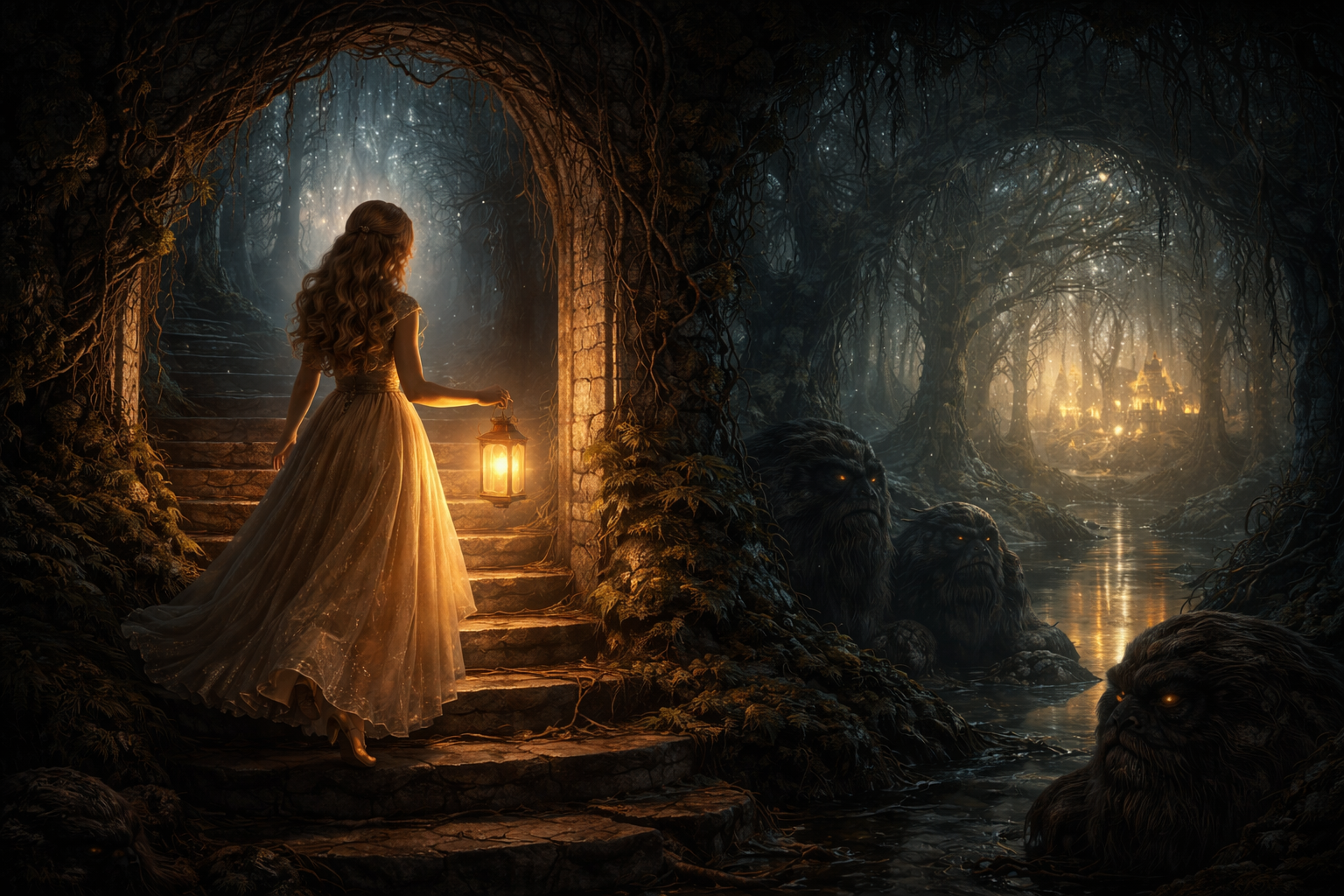
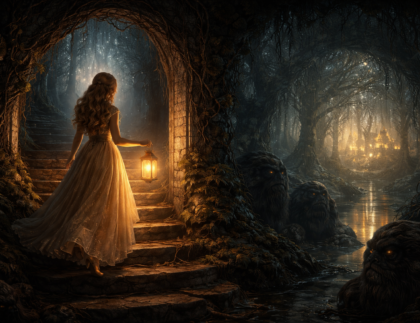
In the Danish tale, a princess wears through twelve pairs of golden shoes each night. No one knows where she goes. No one can see the dance. There is no explanation that makes sense of it in daylight, no story that can be told without sounding impossible.
By morning, though, the evidence is undeniable: worn soles, exhaustion, secrecy. The surface world sees the consequences, but the underworld remains hidden. And because it is hidden, it is also protected. No one can intervene in what they cannot witness.
Trauma Moves Like That
Trauma moves like that. It does not always announce itself with dramatic gestures, obvious breakdowns, or visible chaos. Often, it hides inside what looks like success: competence that never collapses, caretaking that never ends, independence that refuses support, and a kind of “I’m fine” that functions like armour.
It can also hide as charm, as humour, as being the easy one, the helpful one, the un-needy one. Or it can hide as withdrawal, as numbness, as the inability to rest, as the compulsion to descend again and again into relational underworlds that feel strangely familiar. What we call “choice” can quietly become choreography.
We may appear radiant by daylight, but something in us has been waltzing with trolls.
By Daylight, We Appear Intact
By daylight, we may appear intact. Capable. Even radiant. We might be the one others rely on, the one who keeps things moving, the one who holds it all together with a steady voice and a practised smile.
But something in us has been waltzing with trolls. Something has been labouring in secret, spending energy behind the scenes, moving through old corridors at night. And because it happens below awareness, we may not even recognise how much of our life is being shaped by what we have never named.
Unfinished Experience in the Psyche
Trauma lives in the psyche as unfinished experience. As what could not be metabolised when it happened. Not because we were weak, but because it was too much, too fast, too alone, or too confusing for the nervous system to integrate in real time.
So it lodges itself elsewhere: not only in memory, but in posture, in relational expectation, in the nervous system’s subtle scanning of threat. It becomes pattern. It becomes attraction. It becomes the rhythm of who we choose, how we attach, when we leave, when we silence ourselves, when we disappear. It becomes what feels normal, even when it hurts.
The Exhaustion We Can’t Explain
And like the princess, we may not consciously know why we are so tired. We only know we wake with a heaviness that seems disproportionate to the day ahead, or we find ourselves drained after interactions that “shouldn’t” be draining.
We may blame ourselves for lacking resilience, for being too sensitive, for not being more disciplined. But often the fatigue is not laziness. It is the cost of a nightly descent: the cost of holding vigilance, suppressing feeling, managing threat, performing safety, or repeatedly returning to the same underworld in search of a different ending.
Healing is not the banishment of the trolls. It is learning how to waltz without losing yourself.
The Psyche Does Not Erase
The psyche does not discard what overwhelms it. It splits, contains, buries, fragments — but it does not erase. What cannot be carried in awareness is carried elsewhere, often in ways that keep us functional but divided.
These are not moral failures. They are survival strategies. They are the psyche’s intelligence doing its best with the resources available at the time. The trouble is that what once kept us alive can later become the script that keeps us stuck.
The Trolls Beneath the Floorboards
The “trolls” of the fairy tale are not merely monsters. They are archaic forces. Instincts. Unintegrated affects. They are what was exiled because it was unacceptable, terrifying, overwhelming, or simply unsupported.
Shame. Rage. Terror. Grief. Dissociation. They live beneath the polished floors of personality, beneath the version of us that learned how to be palatable, productive, or pleasing. They are not evil. They are un-met. They are the parts of experience that never had a witness, and so they continue to haunt the choreography from below.
The Myth of Healing as Ascent
We often imagine healing as ascent — rising toward light, transcendence, purity. We picture a future self who has moved “beyond” the past, who feels calm and untriggered, who no longer carries the weight, who is finally untouched by the underworld.
But psyche does not heal through avoidance of the underworld. It heals through descent. Not descent as doom, but descent as contact: the willingness to turn toward what has been running the show in secret, and to bring it into relationship with consciousness.
Making the Darkness Conscious
To make the darkness conscious is not to glorify it. It is to turn toward what we have been dancing with unconsciously, without rushing to fix it, spiritualise it, or explain it away. It is to notice the music before we change the steps.
It is to name the pattern. To feel what was once unfelt. To bring symbolic language to what previously only existed as reaction. To recognise that the body has been holding a story, and that story deserves more than discipline. It deserves witness, meaning, and a way to move again.
What Changes When We Consent
When we refuse the descent, the dance continues in secret. It repeats itself behind the scenes, shaping our relationships, our nervous systems, our sense of self, while the surface mind keeps trying to “do better” without understanding what it is really responding to.
When we consent to it, something changes. Not all at once, not as a dramatic breakthrough, but as a slow shift in power. The trolls lose their absolute power when they are seen. What was unnamed becomes nameable. What was compulsive becomes observable. And what can be observed can, eventually, be chosen.
To make the darkness conscious is not to glorify it, but to turn toward what has been moving us in secret.
Trauma Work as Restoration
Trauma work, at its deepest level, is not about erasing what happened. It is about restoring movement where there was freezing, restoring breath where there was bracing, restoring choice where there was compulsion.
It is also about restoring symbolic meaning where there was only survival. Survival is brilliant, but it is not the same as living. When meaning returns, the psyche stops needing to repeat the same descent in order to be heard.
The Function of Consciousness
The princess does not stop dancing because someone tells her to. She stops when the hidden world is witnessed. When what happens at night can finally be seen, the spell begins to loosen.
That is the function of consciousness. Not perfection. Not transcendence. Witness. The steady, compassionate capacity to stay with what is true long enough for it to reorganise.
Bringing the Choreography into Daylight
We do not become enlightened by imagining ourselves as figures of light. We become whole by recognising where we have been descending at night: the places we go internally, the patterns we return to relationally, the old music we still move to.
And then, slowly, gently, we bring that choreography into the daylight. Not to expose ourselves to judgement, but to make the dance available to choice. To let the nervous system learn a new rhythm. To let the psyche discover that it does not have to keep going down alone.
Closing Reflection
Healing is not the banishment of the trolls. It is not a war against the dark, and it is not a demand that we become spotless.
It is learning how to waltz without losing yourself. Learning how to stay present in the underworld without being swallowed by it, how to recognise the music without obeying it, and how to walk back into daylight with your own body still belonging to you.

Read More Recent Reflections

Centre
About
Approach
Appointments
FAQs
Connect
Offering a sacred, compassionate space for women to reconnect with their inner world through Soul Centred Psychotherapy, supporting healing, awareness, and a return to wholeness.
Availability
I’m currently travelling and offering virtual sessions via secure video conferencing. In-person sessions will resume upon my return.
Contact
ivana@evaessence.com.au
Based in Australia
PACFA Member #27247 | ASCP Member
Offering a sacred, compassionate space for women to reconnect with their inner world through Soul Centred Psychotherapy, supporting healing, awareness, and a return to wholeness.
Centre
Contact
ivana@evaessence.com.au
I’m currently travelling and offering virtual sessions via secure video conferencing. In-person sessions will resume upon my return.
Offering a sacred, compassionate space for women to reconnect with their inner world through Soul Centred Psychotherapy, supporting healing, awareness, and a return to wholeness.
Centre
About
Approach
Appointments
Reflections
FAQs
Connect
Contact
ivana@evaessence.com.au
I’m currently travelling and offering virtual sessions via secure video conferencing. In-person sessions will resume upon my return.