On Development, Environment, and the Quiet Power of Brazilian Jiu-Jitsu
We are living in a time of rapid psychological development — particularly for children — shaped increasingly by artificial intelligence. Yet, as we move further into this progression, something quieter appears to be diminishing.
A deeper human connection.
A felt sense of empathy.
And in its place, a subtle disorientation is emerging — especially among teens and young adults.
Disconnection & Its Impact
Many are experiencing increasing levels of isolation. This is becoming visible in younger populations, where there has been a noticeable rise in the use of psychiatric medications in children and adolescents.
While such interventions may be necessary in some cases, this trend raises important questions about how early we begin to pathologise developmental responses.
Particularly when behaviours may be rooted in relational, environmental, or developmental factors that have not yet been fully understood.
Rethinking Disorder
In this way, what is being pathologised may instead be an expression of adaptation.
A child or individual responding to a misattuned environment may present behaviours that appear disruptive or irregular. However, these behaviours may be deeply meaningful when understood within the context of their lived experience.
To reduce these expressions to pathology alone risks losing the underlying message they carry.
Developmental research has long suggested that children’s behaviours are deeply shaped by their relational environments, and that what presents outwardly often reflects something unresolved within that field.
Identity & Cultural Influence
At the same time, we are witnessing increasing confusion around identity.
When individuals become uncertain of who they are — including questions around sex, gender, and self-concept — it may not simply be a personal issue, but a reflection of a broader cultural and psychological landscape.
There are also social and economic systems that may, consciously or unconsciously, reinforce and even benefit from this uncertainty.
In such an environment, identity can become something shaped externally, rather than discovered through lived experience.
Some clinicians have raised concern around the growing tendency to medicalise normal variations in human behaviour — particularly when developmental processes are still unfolding.
“Not every child needs a label. Some need time, attunement, and space to unfold.”
Children & Early Intervention
My concern does not lie with adults who choose interventions with awareness and agency.
Rather, it rests with children — those moving through critical developmental stages, particularly in their teenage years — where confusion is not only natural, but necessary.
Clinical guidelines continue to emphasise relational and psychological approaches as a first-line response before medication is introduced, particularly in younger populations.
When this developmental process is met too quickly with labels or medication, especially when combined with environmental pressures, it may create a form of distortion.
A person may begin to organise themselves around an imposed identity or diagnosis, rather than discovering it through time, relationship, and experience.
An Embodied Alternative
Perhaps part of what is missing in our current approach is not more intervention — but a return to embodied experience.
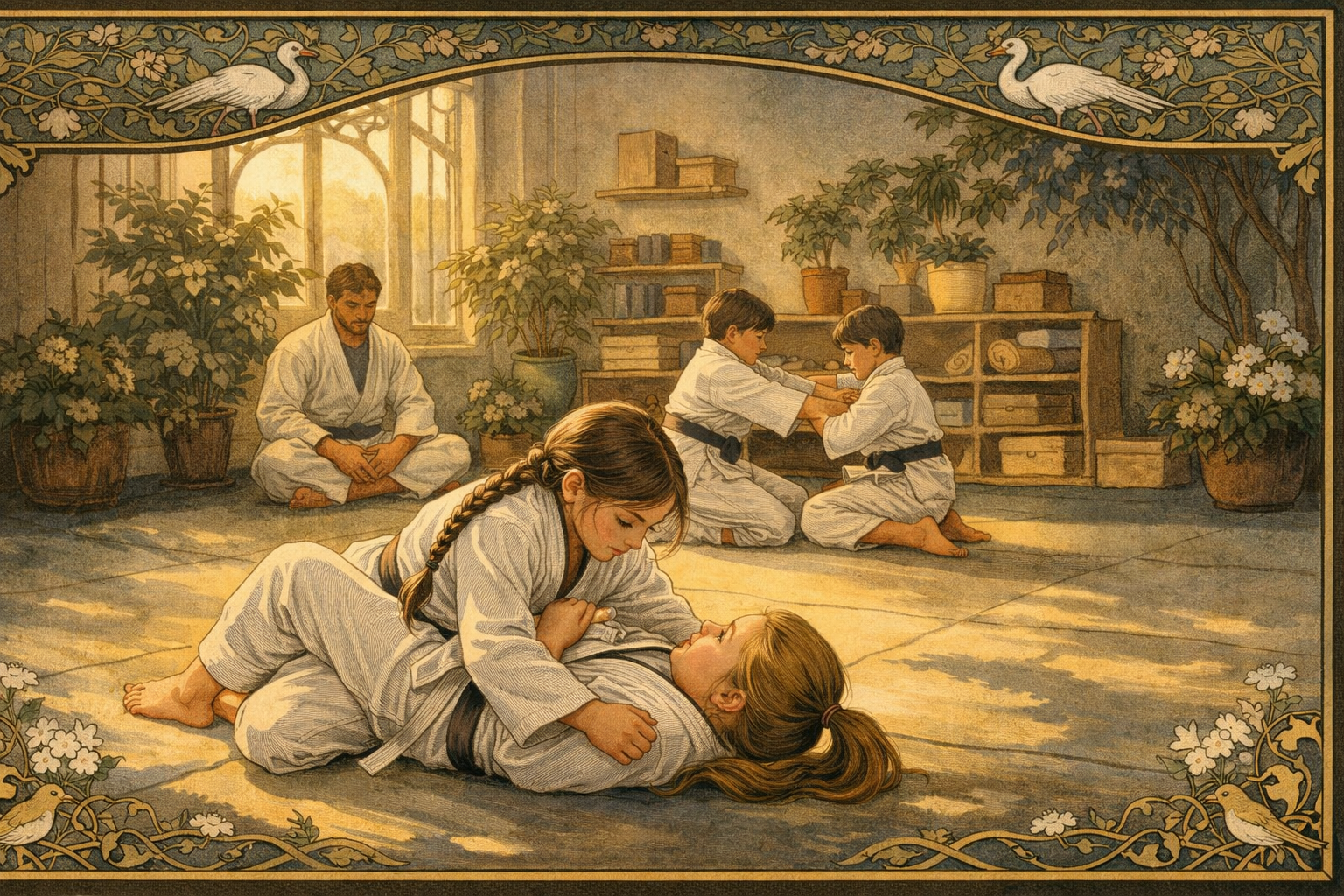
Practices such as Brazilian jiu-jitsu, and other martial arts, offer a profoundly different pathway for development — one that is not constructed through abstraction, but through direct, lived engagement.
It is important to name that practices such as Brazilian jiu-jitsu are often misunderstood as forms of self-defence alone.
While they do offer protection against external threat, their value extends far beyond this.
At a deeper level, they are practices of inner organisation.
They cultivate the capacity to remain present under pressure, to regulate internal states, and to engage with another without collapsing, avoiding, or overpowering.
Within these practices, an individual is brought into immediate contact with themselves and another. There is no distance. No performance. Only presence.
The close physical proximity, the pressure, and the constant negotiation of movement require a deep level of self-awareness and regulation. One must learn how to remain composed under stress, how to respond rather than react, and how to stay oriented within intensity.
At the same time, these environments cultivate relational intelligence.
Through grappling, one begins to sense the other — to anticipate movement, to attune to subtle shifts, and to respond in real time. It is a dialogue of the body, rather than the intellect.
This kind of practice builds not only endurance and focus, but also a grounded sense of self — one that emerges through experience rather than conceptual identity.
For children especially, this offers something essential: a way to develop attention, discipline, and relational capacity through the body, rather than through external labelling or premature categorisation.
It gives a feeling of internal stability — one that is built through lived experience, not imposed from the outside.
The Honesty of the Practice
There is also a particular honesty within this practice that is difficult to replicate elsewhere.
There is no fast-tracking to a black belt.
No weekend workshop that grants mastery.
There is only time — and a sustained commitment to oneself, to the practice, and to the mat, over years and years.
In this way, it cultivates patience.
It becomes a form of development through continued commitment — of the psyche to the practice — where one is constantly evolving.
And there is always someone more skilled, someone who can meet you, challenge you, and surpass you.
This keeps the individual humbled, the ego in check, and the practice real.
“The question remains: are we supporting the unfolding of the individual, or are we shaping them too quickly into something they have not yet had the time to become?”
On Technique, Not Force
There is also something fundamental within this practice that challenges conventional ideas of power.
Size and sheer strength do not hold the authority one might expect.
It is not force that determines the outcome — but technique, positioning, timing, and awareness.
Rather, it is the capacity to adapt, to feel, and to respond with precision that shapes the exchange.
In this way, Brazilian jiu-jitsu becomes deeply empowering — particularly for women.
Because it offers something that extends beyond physical strength.
It is inherently defensive, yet highly effective.
Through leverage, positioning, and refined technique, a smaller individual can neutralise, control, and overcome someone significantly larger or stronger.
What appears powerful on the surface is reorganised through skill.
And the body learns — not through force, but through understanding.
In this, power is redefined.
Not as domination, but as the ability to remain composed, responsive, and effective within pressure.
What Research Is Beginning to Show
There is also emerging research that begins to support what is observed within these practices.
Studies exploring Brazilian jiu-jitsu and other martial arts suggest improvements in emotional regulation, behavioural stability, and self-control in children, alongside increased resilience, confidence, and overall psychological wellbeing.
In some contexts, these environments are described as supporting psychosocial development — where pressure, contact, and relational engagement foster internal coping capacities.
While this area of research is still developing, the direction is clear: there is something within these embodied practices that supports the organisation of the individual from within.
Integration of the Self
There is also something further that emerges through this kind of embodied practice.
Brazilian jiu-jitsu allows an individual to begin inhabiting more of their internal space.
For those who struggle with self-esteem, or with a diminished sense of self, it offers a pathway into parts of the self that have long been overlooked, quietened, or overshadowed.
Through the body, one begins not only to embody — but to reclaim.
To come into contact with previously inaccessible aspects of self, and gradually take ownership of them through lived experience.
This is not imposed identity.
It is integration.
A sense of self that is not constructed externally, but formed through direct engagement with pressure, relationship, and presence.
In this way, the individual does not simply become more capable — they become more whole.
Closing Reflection
For those unfamiliar with this perspective, it may sound abstract, or even confronting.
Yet what is being pointed to here is not a rejection of support — but a reconsideration of how we understand development itself.
Because the question remains:
Are we supporting the unfolding of the individual…
or are we shaping them too quickly into something they have not yet had the time to become?

References:
1. Rank-Based Psychological Characteristics in Brazilian Jiu-Jitsu Athletes: Mental Strength, Resilience, Grit, Self-Efficacy, Self-Control, Aggression, Life Satisfaction, and Mental Health
https://pubmed.ncbi.nlm.nih.gov/40126339/
2. Effects of a school-based Brazilian jiu-jitsu programme on mental health and classroom behaviour of children from Abu Dhabi: a randomised trial
https://pubmed.ncbi.nlm.nih.gov/40126339/
3. Aggression, self-control, life satisfaction, and resilience as predictors of mental health in Brazilian jiu-jitsu athletes
https://pmc.ncbi.nlm.nih.gov/articles/PMC12631182/
4. Effects of a school-based Brazilian jiu-jitsu programme on mental health and classroom behaviour of children from Abu Dhabi: a randomised trial
https://www.researchgate.net/publication/362664907_Effects_of_a_school-based_Brazilian_jiu-jitsu_programme_on_mental_health_and_classroom_behaviour_of_children_from_Abu_Dhabi_a_randomised_trial
5. Benefits of Brazilian Jiu-Jitsu in Managing Post-Traumatic Stress Disorder: A Longitudinal Study
https://www.researchgate.net/publication/359096627_Benefits_of_Brazilian_Jiu-Jitsu_in_Managing_Post-Traumatic_Stress_Disorder_A_Longitudinal_Study
6. The Social-Psychological Outcomes of Martial Arts Practise Among Youth: A Review
https://pmc.ncbi.nlm.nih.gov/articles/PMC3761807/
Read More Recent Reflections


Centre
About
Approach
Appointments
FAQs
Connect
Offering a sacred, compassionate space for women to reconnect with their inner world through Soul Centred Psychotherapy, supporting healing, awareness, and a return to wholeness.
Availability
I’m currently travelling and offering virtual sessions via secure video conferencing. In-person sessions will resume upon my return.
Contact
ivana@evaessence.com.au
Based in Australia
PACFA Member #27247 | ASCP Member
Offering a sacred, compassionate space for women to reconnect with their inner world through Soul Centred Psychotherapy, supporting healing, awareness, and a return to wholeness.
Centre
Contact
ivana@evaessence.com.au
I’m currently travelling and offering virtual sessions via secure video conferencing. In-person sessions will resume upon my return.
Offering a sacred, compassionate space for women to reconnect with their inner world through Soul Centred Psychotherapy, supporting healing, awareness, and a return to wholeness.
Centre
About
Approach
Appointments
Reflections
FAQs
Connect
Contact
ivana@evaessence.com.au
I’m currently travelling and offering virtual sessions via secure video conferencing. In-person sessions will resume upon my return.