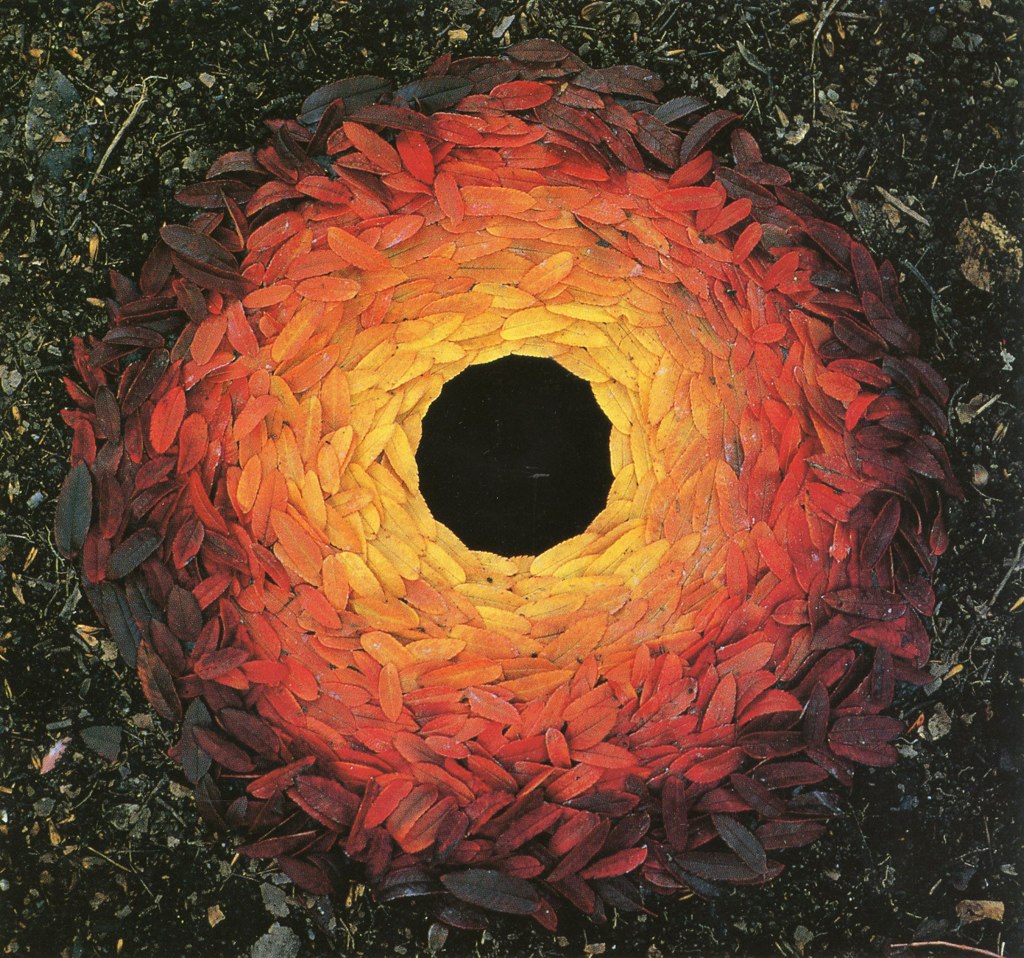
I’m often reminded of the work of environmental artist Andy Goldsworthy, whose art emerges from the quiet collaboration between form, nature, and impermanence. His leaf-spirals, stone circles, and woven material compositions are created only to be transformed by the elements — touched by wind, dissolved by rain, carried away by tide or season. Much like the nervous system in its healing process, his pieces reveal how rupture and re-formation exist side by side. Nothing returns to its original shape, yet something new, coherent and alive arises from the shifting materials. His art becomes a living metaphor for trauma integration — the way beauty, order, and meaning can slowly reassemble themselves from fragments when held within the right conditions.
As a Soul Centred Psychotherapist, I often witness how pain and trauma, while deeply challenging, can also become profound gateways to transformation. Healing does not mean returning to who we once were, but rather engaging with the possibility of who we might become through the integration of our lived experience.
Michael Meade once wrote, “the wound becomes a womb from which we are intended to be reborn again and again.”
The idea that trauma can open us in ways that are deeply healing and inherently creative offers a powerful perspective on the human experience. To be clear, I wish no trauma upon anyone — yet the potential for healing, regeneration, and transformation that exists within us is extraordinary. Our ability to heal — to adapt, to change, to become — is a uniquely human capacity.
The wound is not only a mark of what has been lost or broken, but also a portal through which transformation and renewal can occur.
Despite what we have endured, and how those experiences have shaped us internally, we possess an innate drive to integrate, merge, and weave ourselves back into wholeness. We are never the same as before, but through the process of healing, we often become more expansive, aware, and connected to life itself.
I’m reminded of a tree struck down by lightning during a storm. Though it has fallen, the tree becomes host to new life — fungi, moss, and other organisms forming a rich, symbiotic ecosystem. The tree is no longer what it once was, yet in its transformation it becomes something profoundly alive — a living, breathing network that supports and sustains new growth.
Dr. Gabor Maté describes trauma not as the event itself, but as what happens within us as a result of it.
Healing, then, involves developing the capacity to observe our inner experience with curiosity and care — to become a witness to our own internal processes.
This involves asking ourselves:
- What is happening to me right now?
- What is being triggered in me?
- What is being activated or remembered?
- What sensations or emotions arise?
- How am I experiencing this in my body?
- Where in my body does this live?
Engaging with these questions cultivates awareness and presence. This act of witnessing ourselves — with compassion rather than judgment — becomes a vital part of the healing process. When combined with interpersonal psychotherapy, the therapist serves as a safe and attuned container, holding and mirroring the unfolding contents of this process. Within this relational field, integration can occur in a way that feels adaptive and secure. As we move through trauma processing, the neural pathways between the left and right hemispheres of the brain begin to repair, allowing certain memories to surface for further processing and healing.
In this light, the wound is not only a mark of what has been lost or broken, but also a portal through which transformation and renewal can occur.
Through my work, I see this truth reflected time and again — that healing is rarely a return to what was, but an unfolding into a deeper, more integrated sense of being. In attending to our wounds, we rediscover that re-generation is possible and our capacity to move toward life.
What Happens Physiologically When We Experience Trauma
Let’s take a moment to talk about what trauma actually is.
Not everything that is painful, sad, or distressing is necessarily traumatic — though traumatic experiences can hold all of those feelings, and often much more.
Trauma can be understood as too much, too soon, or too overwhelming for our system to process at the time. When this happens, our body instinctively activates one of its survival responses — fight, flight, or freeze. These are neurological and physiological mechanisms designed to protect us from perceived threat or danger.
When we enter these states, our body releases stress hormones such as cortisol and adrenaline. In the short term, these chemicals help us survive. But when the stress response is prolonged or repeatedly activated over time, elevated cortisol levels can begin to affect the brain’s functioning — particularly the communication pathways between the left and right hemispheres.
As a result, memory, focus, and emotional regulation can become impaired. This is why people who have experienced trauma often describe feeling disconnected, foggy, or unable to recall certain events clearly.
“The afflicted are holy.”
- Michael Meade
Healing from trauma involves restoring safety and connection — both within the body, the nervous system and through interpersonal connection of the ‘other’. Through gentle awareness, grounding practices, and compassionate therapeutic presence, the system can begin to regulate again. Over time, this allows new neural pathways to form, integrating what was once fragmented or overwhelming. In Soul Centred Psychotherapy, this process supports the body and psyche to reconnect, repair, and return to an innate state of coherence and wholeness.
When the Nervous System Feels Hijacked
When the nervous system becomes dysregulated — whether through stress, trauma, or overwhelm — our physiological and neurological responses can feel as though they have taken over. In these moments, grounding and self-regulation are essential.
It’s important to remember that there is no quick ‘fix’ in therapy. Healing involves a gradual process of repetitive, consistent repair over time. Through emotional regulation, attuned mirroring, and somatic processing, the brain slowly develops new neural pathways. Practices such as EMDR, bilateral stimulation, and other integrative techniques support communication between the left and right hemispheres of the brain, allowing for more adaptive responses to stress.
Developing familiarity with new regulatory practices helps the nervous system form stable and habitual patterns of homeostasis. Over time, these patterns become embodied and can be accessed more readily during moments of distress.
Practical self-regulation techniques include:
- Body scanning: Observing and mapping sensations in the body when entering a state of overwhelm. Awareness of physiological cues is essential and can facilitate movement and release of stored tension.
- Focusing and giving form: A somatic technique that supports embodiment and regulated expression of emotional material.
- Creative therapies: Engaging in art-making, journaling, or expressive modalities to externalize and integrate emotional experience.
- Movement-based therapies: Dance, mindful movement, or other forms of physical engagement help regulate arousal and restore body-mind coherence.
- Music therapy: Listening to or creating music to soothe or stimulate the nervous system, depending on need.
- Walking: Gentle rhythmic movement supports bilateral integration and grounding.
- Bilateral stimulation through music: Alternating auditory stimulation can support hemispheric communication and emotional integration.
- Marching: Structured, rhythmic movement (refer to my → fatigue video for guidance).
- Trauma or anxiety tapping: Gentle tapping sequences can reduce distress and support regulation (→ guided video available online).
These practices aim to cultivate self-awareness, enhance nervous system regulation, and complement the therapeutic process by strengthening internal resources between sessions.
“Using the power of imagination, we can try to conceive of the experience of the hijacked consciousness. […] We’ve all had times in our lives when intuition and circumstances compelled us to make choices that seemed absurd. In these moments, we say we are guided by “God” or “ancestors” or “madness”. And, when such moments regard making art, we say we are inspired. We are serving the godhead, Hermes, the imaginal realm, the collective unconscious, the “aliveness” of the world.” – Sophie Strand, Body is a Doorway
By allowing the wings of your wound to take root within the body, a deeper symbiotic state can emerge — opening the possibility for healing and transformation.

Read More Recent Reflections


Centre
About
Approach
Appointments
FAQs
Connect
Offering a sacred, compassionate space for women to reconnect with their inner world through Soul Centred Psychotherapy, supporting healing, awareness, and a return to wholeness.
Availability
I’m currently travelling and offering virtual sessions via secure video conferencing. In-person sessions will resume upon my return.
Contact
ivana@evaessence.com.au
Based in Australia
PACFA Member #27247 | ASCP Member
Offering a sacred, compassionate space for women to reconnect with their inner world through Soul Centred Psychotherapy, supporting healing, awareness, and a return to wholeness.
Centre
Contact
ivana@evaessence.com.au
I’m currently travelling and offering virtual sessions via secure video conferencing. In-person sessions will resume upon my return.
Offering a sacred, compassionate space for women to reconnect with their inner world through Soul Centred Psychotherapy, supporting healing, awareness, and a return to wholeness.
Centre
About
Approach
Appointments
Reflections
FAQs
Connect
Contact
ivana@evaessence.com.au
I’m currently travelling and offering virtual sessions via secure video conferencing. In-person sessions will resume upon my return.