Remembering the Roots
So… where do your archaic bones live? Are you in resonance with them?
When you work with Spirit, does it arise from a place of deep inner purpose and holding — or has it become a playful pursuit, a social-media performance that no longer carries meaning?
Whether you’re a practising psychic medium or simply curious — perhaps even feeling lost within the vast fantasia of your own “Spirit World” — it’s easy to drift away from grounded truth.
Without roots, we begin to project confusion outward.
Without roots, we begin to project confusion outward: offering unsolicited readings, invoking fear with words such as “You have an entity attached to you,” or “There’s negative energy around you.” Such statements can leave deep imprints on tender souls.
In this space, I want to unearth ways to cultivate a deeper connection — first and foremost to yourself. From that embodied place, connection to Spirit, nature, and others naturally follows.
The Body as Sacred Ground
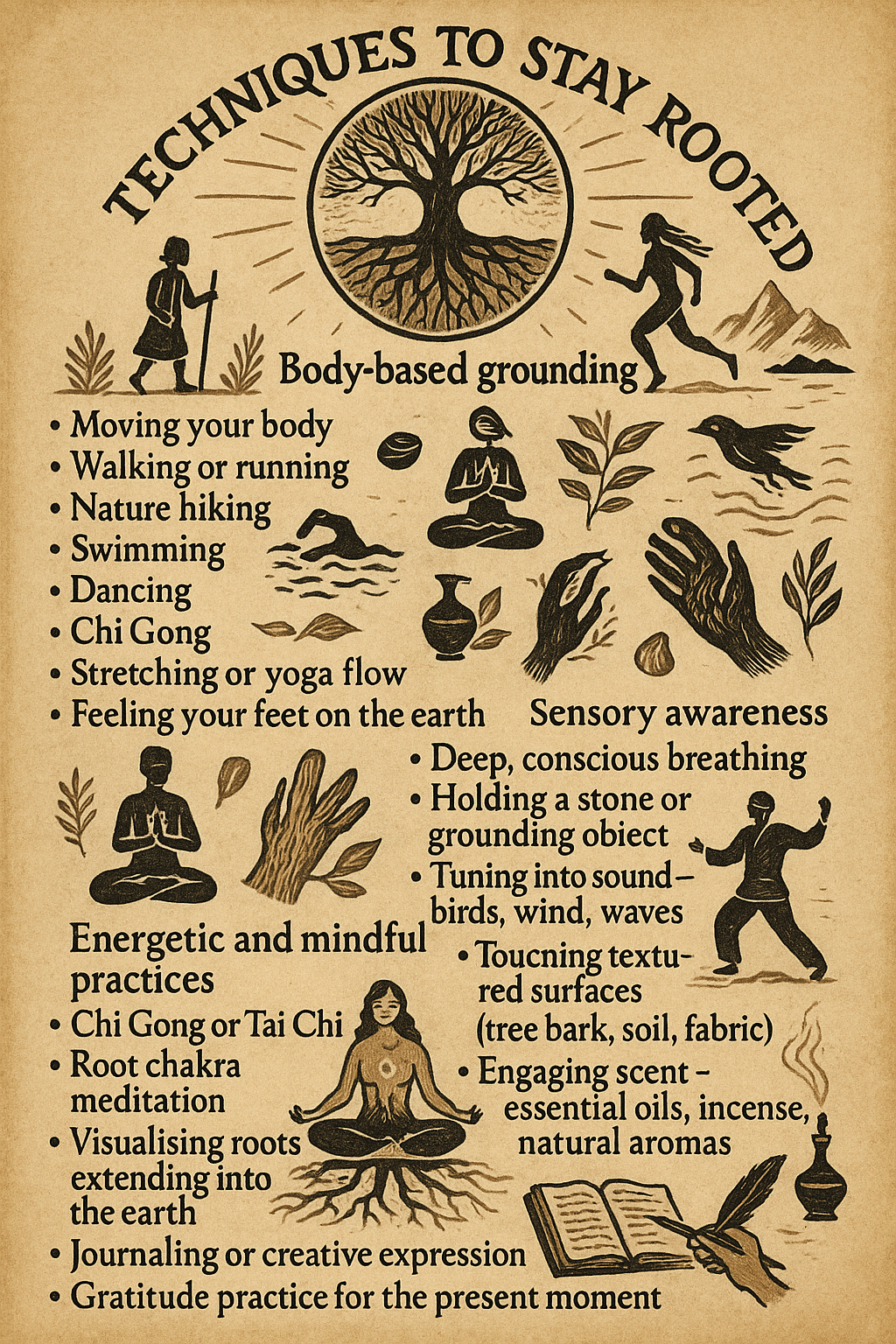
To deepen communion with Spirit, you must first return home to your body. If this feels difficult — if your awareness hovers outside your form — it may be a sign of trauma.
In my experience, those who find embodiment challenging often carry early imprints of violation or intrusion. Entering inward can feel frightening, even painful. Yet this is where healing begins.
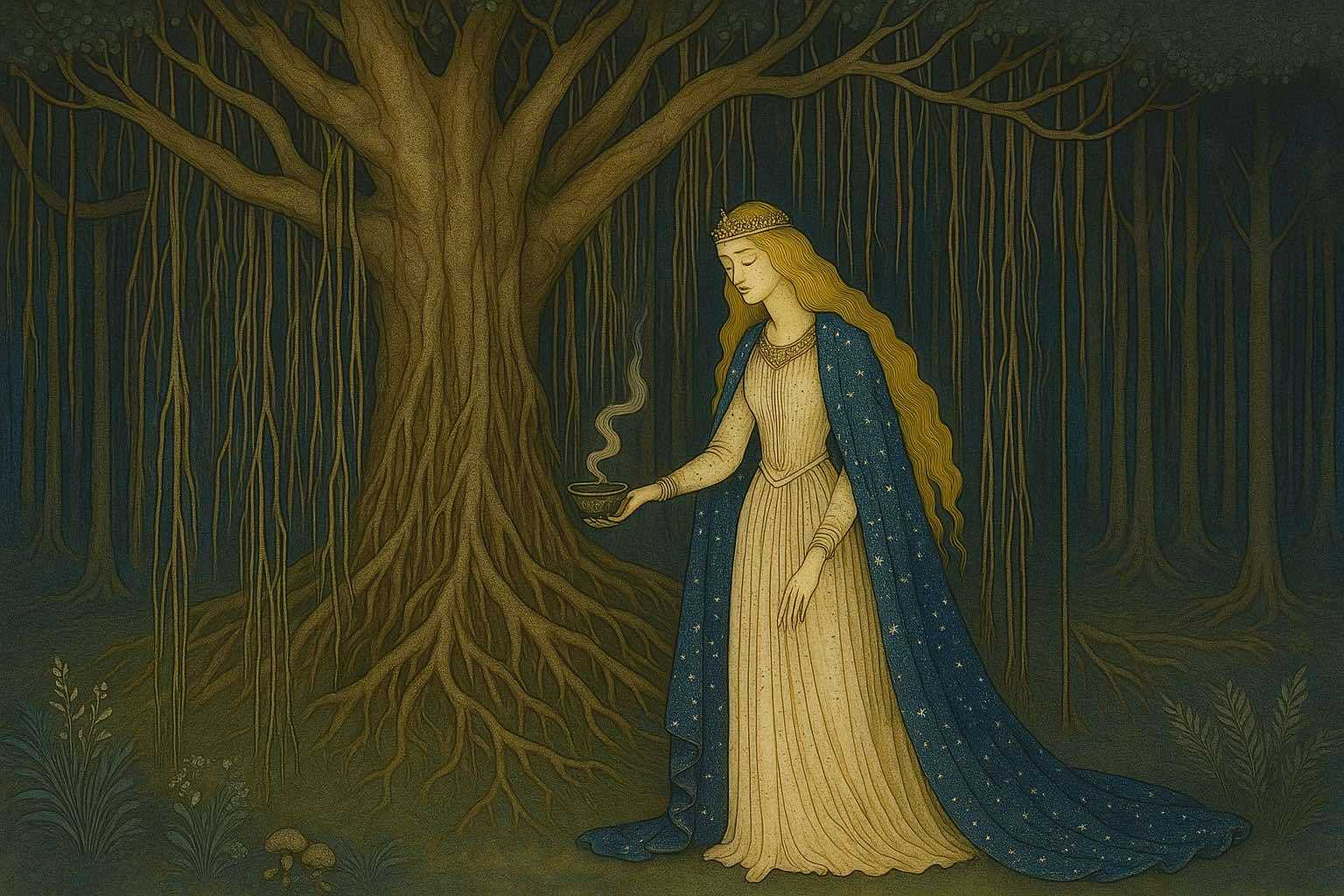
Think of a tree.
Science and nature alike reveal how trees communicate — above ground through the movement of their branches, and below ground through intricate root systems and the mycelial web¹ . Connection happens through both light and darkness.
So what does it mean to be rooted — truly rooted — in our postmodern world? After centuries of human separation from nature — from the wisdom of the land, the sacred feminine, and Indigenous traditions that once guided humanity — we are being called to remember.
To return to the Earth, not as conquerors or seekers of power, but as humble kin.
The great forgetting began when the world turned away from the sacredness of the natural world — when the divine was lifted to the sky and removed from the soil beneath our feet. In that disconnection, we lost the language of intuition, of cyclical knowing, of listening to the pulse of life itself.
Now, the invitation is to root again — to anchor your spirituality not in escape, but in presence.
Now, the invitation is to root again. To anchor your spirituality not in escape, but in presence. To listen to the body as you would to Spirit. To let the wind, the trees, and the rivers remind you of what you’ve always known —
that spirituality is not above you or beyond you, but living through you, here, in this very moment.
Remembering the Old Ways
You see, the word pagan comes from a Latin word paganus, meaning peasant —
the common folk who lived close to the land and both feet on the ground.²
Their wisdom was not abstract or detached;
it was embodied, relational, and rooted in the rhythms of the Earth.
They listened to the seasons and the silence between storms.
They learned to live with the world rather than apart from it.
Their folktales were not mere entertainment —
they were encoded teachings, riddles, and maps for the soul.
Each story held a way to navigate the unseen,
to find harmony within the cycles of life and death.
Their folktales were not mere entertainment — they were encoded teachings, riddles, and maps for the soul.
Myth, in turn, became a living philosophy —
a sacred architecture that housed the deeper patterns of the psyche.
In this way, myth and story were much like the tarot.
The Major Arcana reflected the great archetypal forces —
the universal themes that move through all human experience —
while the Minor Arcana held the intimate details of daily life:
the struggles, choices, and moments of awakening.
Each tale shifted as it travelled from tribe to tribe,
just as tarot imagery evolved across time —
changing slightly to meet the landscape,
yet carrying within it the same ancestral pulse.
Through these living symbols, our ancestors remembered who they were.
Perhaps to be rooted in your spirituality today means to listen for that same pulse —
to feel the whisper of the old stories in your bones,
to walk gently with the Earth that still remembers us,
and to become, once again, part of the conversation.
A Reflection on Sacred Animacy
One of my favourite quotes comes from Sophie Strand:
“If we pray we must ask ourselves: Do our prayers have roots?
Do our gods sometimes grow fur?
Do our holy words sprout leaves?
Does our spirituality connect us to our situated ecosystem?”³
What stands out to me most in this passage is the intimacy of God within the natural world.
This is not a distant, disembodied God — not one who watches from afar — but a presence woven into the very womb of existence.
This God breathes amongst us,
in every tree, every river, every creature that crosses our path. The beauty of animacy is that it is not separate from us; it lives through us, as we live through it.
The sanctuary of the trees is our home. The wind — our shared breath.
As Sophie Strand so beautifully reminds us:
“The ground really does provide a soil womb for the food that we will eat and metabolise into music, laughter, dance, heated breath on a windowpane, lovemaking. The fungi really do hold forests together and provide a medicine that heals our brains and rewires our immune systems.” ⁴
In this way, the sacred is not something to ascend toward — it is something we root into.
Divinity is not above us; it grows through us — leaf by leaf, breath by breath.
Their folktales were not mere entertainment — they were encoded teachings, riddles, and maps for the soul.
In this way, the sacred is not something to ascend toward — it is something we root into. Divinity is not above us; it grows through us — leaf by leaf, breath by breath.
Closing Reflection
To live a rooted spirituality is to remember that Spirit does not float above us — it moves through us.
It breathes in the soil beneath our feet, in the pulse of our bodies,
in the stories our ancestors once told to keep the fire of meaning alive.
Perhaps the work now is not to reach higher, but to grow deeper.
To let our prayers find roots.
To let our faith grow fur and leaf, breath and heartbeat.
To speak again the language of myth and of tree,
and to remember that divinity was never lost —
only waiting for us here,
in the living world that has always been our home.
Closing Reverie
“And one way to understand the modern world, is a world that’s fallen out of grace. The sense of grace and gratitude are actually big things that are supportive of human life but also that are indications of the growth of the spiritual and soulful sense of oneself. Gratitude involves a state of wholeness even if it lasts only for a moment. Gratitude requires that we are whole for a moment. Everything comes together and we feel grateful for the gift of life.”
— Michael Meade

References
1. Rooted, Life and the crossroads of Science, Nature and Spirit by Lynda Lynn Haupt pg172
2. Archetypal Patterns in Fairy Tales by Marie-Louise Von Franz, pg75
3. The Body is a Doorway, A memoir by Sophie Strand pg211
4. The Body is a Doorway, A memoir by Sophie Strand pg210
Read More Recent Reveries

Centre
Connecting you with the spirit world through authentic mediumship. Sharing messages that bring understanding, comfort, and peace of mind.
Availability
I’m currently travelling and offering virtual sessions via secure video conferencing. In-person sessions will resume upon my return.
Contact
ivana@evaessence.com.au
Based in Australia
Connecting you with the spirit world through authentic mediumship. Sharing messages that bring understanding, comfort, and peace of mind.
Connecting you with the spirit world through authentic mediumship. Sharing messages that bring understanding, comfort, and peace of mind.